A Solid Foundation: How 501(c)(25)s Can Keep Land in Community Hands
Narrated by Aleeyah Frye
Written by Darby Weaver
A 501(c)(25) is an unusual tax declaration because it both requires collaboration with three or more member organizations that co-create it, and it has the sole and specific purpose of holding and managing real property (LAND)! That specialization makes it a powerful tool for communities seeking to collaboratively own working farms. Below, we will explain what sets a 501(c)(25) apart from other tax-exempt entity structures and detail how they are central to the foundations of the Farmland Commons projects.
Creation of 501(c)(25) Internal Revenue Service (IRS) Designation
Congress created the 501(c)(25) designation through the Tax Reform Act of 1986 as a highly specialized tax-exempt status to allow unrelated tax-exempt entities such as 501(c)(3)s, 401(a) pension or profit-sharing funds, and units of government to pool their resources to acquire, hold title to, and manage property while insulating the parent organizations from direct liability. The designation was established to solve a massive loophole and liability crisis facing entities that wanted to invest in real estate. With recognition that real estate can be prohibitively expensive, and many small and mid-size entities are only able to acquire land by pooling their resources, the 501(c)(25) designation both acts as a corporate shield for group investing and allows up to 35 entities to combine their funds into one single entity to buy, hold, and manage real estate.
501(c)(3) vs. 501(c)(25)
A nonprofit is sometimes thought of as an organization that doesn’t earn money or generate income. In reality, a nonprofit is an organization whose assets and earnings are dedicated to a defined purpose rather than distributed to private owners or shareholders. In other words, there are no individuals who own the organization and are entitled to take its profits for themselves. Instead, the organization holds its assets and uses its resources to further its stated mission with public benefit. This distinction becomes especially important when the asset in question is land; a nonprofit can own land not as an investment to be sold for someone’s private gain, but as an asset held in service of a larger, enduring purpose.
A 501(c) is a section of the US Internal Revenue Code that gives federal tax-exempt status to nonprofit organizations. A nonprofit must have a mission that qualifies as operating for public benefit under terms determined by the IRS. The most familiar type of nonprofit is the 501(c)(3), an organization generally formed to serve charitable, educational, religious, scientific, or other qualifying purposes. These organizations can receive tax-deductible charitable contributions and may carry out programs and activities including fundraising in support of their mission. In exchange for these benefits, they are subject to specific rules, including restrictions on private benefit and certain political activity. While a 501(c)(3) can take many forms and perform a wide range of functions, its basic purpose is to use its resources in service of a recognized public good rather than for the private gain of individuals. Many education, hospital, and service organizations are nonprofits, as are land trusts, food assistance, and social service organizations.
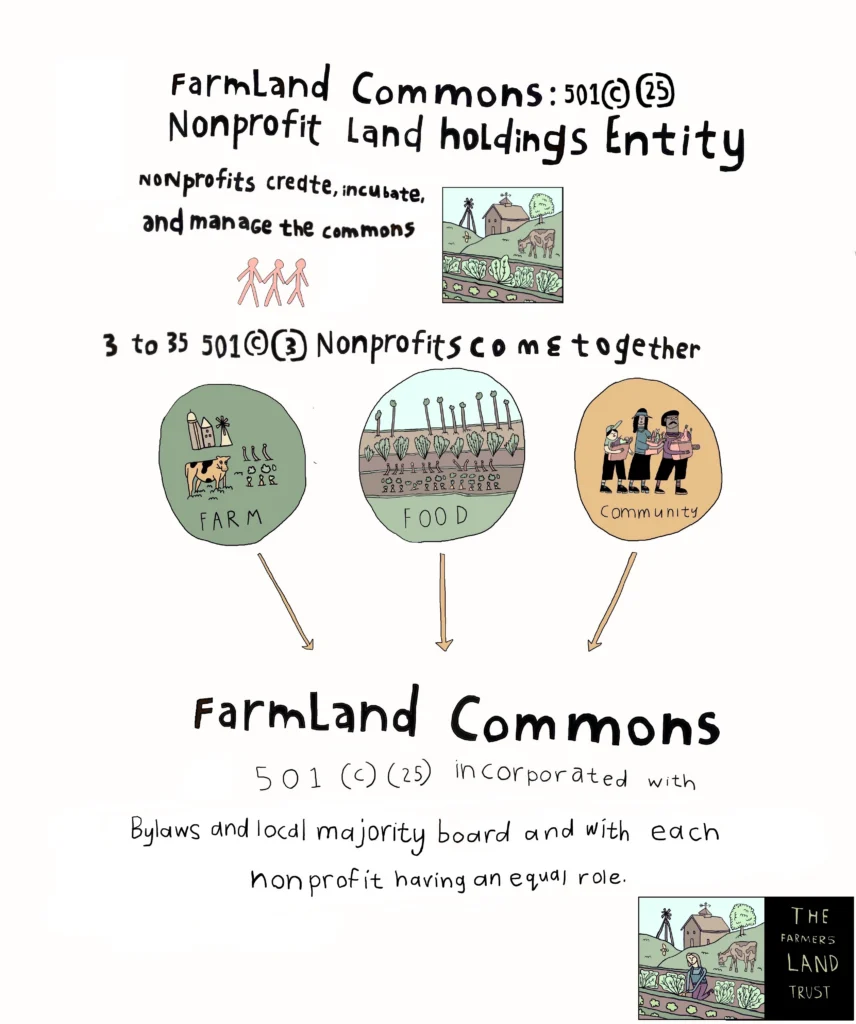
A 501(c)(25) also refers to a specific category of tax-exempt organization under the Internal Revenue Code. Unlike the much more familiar 501(c)(3), the 501(c)(25) is relatively specialized. A 501(c)(25) is designed to hold title to real estate and collect income from that property for the benefit of three or more qualifying tax-exempt 501(c)(3)s, 401(a) pension or profit-sharing funds, and units of government entities. Unlike a 501(c)(3), which can exist to carry out a broad range of charitable activities and programs, a 501(c)(25) is much more narrowly focused on the title-holding ownership and management of real property. Its purpose is not simply to own land as an investment, but to hold it within a tax-exempt structure driven by mission and values.
A 501(c)(25) can purchase, hold, manage, and collect income from real estate. It can be made up of up to 35 shareholder or beneficiary entities. All earnings from the held real estate, excluding funds used for the expenses of operating the 501(c)(25) and managing and holding the land, are given annually to its tax-exempt parent entities. This structure accomplishes two major goals:
- Liability Isolation: It completely insulates the parent entities from lawsuits and liability related to the real estate.
- Democratization of Real Estate Access and Ownership: It allows smaller entities to own and access real estate by collectively investing, owning and managing high-value real estate.
Durability of the 501(c)(25)
The structure of a nonprofit moves beyond the person or business to establish a board-run, mission-driven organization that is designed to outlive those who created it. The bylaws, along with state and federal oversight, allow participants to consider the future of the land and put in place systems that facilitate structured transitions of the board and staff to create continuity. There are several examples of nonprofits incorporated in Boston in the mid 1600s that are still operating today, demonstrating the sustainability and durability of a nonprofit entity far beyond the person’s or business’s lifespan.
While there is the potential for multi-generational longevity, nonprofits do come and go, as is true with any legal entity. The 501(c)(25) designation accounts for this and creates a far more durable and lasting structure through the required collaboration of three to 35 member entities that are allowed to exit and enter over time. Thus, a nonprofit that ceases to exist may be replaced by a new member, or it may simply exit if three or more members remain.
Holding the Land
Rather than being a charitable vehicle with varied and diverse activities, the 501(c)(25) is specifically designed around property ownership and title holding, which makes it an ideal tool for the creation of Farmland Commons. As explained in great detail through literature written by the late Elinor Ostrom, the creation and longevity of a Commons hinges on rules, relationships, governance, and a mind toward the resources’ continuity and future. In this case, the 501(c)(25) functions as a part of the institutional infrastructure. It becomes a legal entity that holds title to the land, removing it from the speculative real estate market. The governance of the Farmland Commons is made up of a collective of 501(c)(3)s and other qualified entities that have come together as the beneficiaries of the 501(c)(25) with a shared mission and vision for the land’s use.

Separating ownership from use is a powerful tool that allows the work of legally holding and managing property to be completed by different people than those who will be boots on the ground, tending the land. This separation is an essential feature in many Indigenous, peasant, and native societies where the land is held and used collectively. In contrast, the American pioneer and homesteading story that swept European settlers from East to West on the wings of “manifest destiny” was a historically unique phenomenon where private land ownership was a tool used to steal land. That theft and privatization of the land has solidified generations of land privilege that have fueled inequities and wealth gaps that continue to grow today.
Separating ownership from use requires mindful governance. For instance, corporate entities that extract water, minerals, timber, and other precious resources do not own the land but gain rights to use the land. Through this separation of ownership and use, they are able to take what they need, degrading the land without owning the liability, responsibility, or restoration of the land itself. It is for this reason that the land’s ownership must be held in the intentionality and spirit of the community it is impacting. As Elinor Ostrom once said, “There is no reason to believe that bureaucrats and politicians, no matter how well-meaning, are better at solving problems than the people on the spot, who have the strongest incentive to get the solution right.”
Through the Farmland Commons model, the land can be held in perpetuity, while generations of land stewards pass through the property, offering their gifts to the land and people. The longer horizon of a nonprofit structure beyond one human lifetime ensures that an essential resource and community asset is maintained and kept available now and into the future. By removing the land from the speculative real estate market, there is no chance of the land being lost to development or a quick sale at the end of one farmer’s tenure. Future farmers of the land in this model inherit an opportunity rather than the debt associated with the rising costs of land. Through the Farmland Commons, both land access and land succession are succinctly addressed.
More than a Tax Code
While the legal structure holding the land involves a lot of paperwork that is often completed with the help of legal counsel, what results from this tedious process helps determine the land’s future. Bigger than tax exemption and so much more than tax code, the 501(c)(25) is the very tool wielded by our team to restructure our current land-ownership model and create something much more equitable, enduring, and replicable across the United States. While each state has different regulations for property ownership, a version of this foundation can be built across the country, and land can be removed from its vulnerable position of private ownership within the speculative real estate market. Freeing the land from that burden frees the farmers from the economic burden of holding it and places the power back into the hands of the communities who benefit from the shared resource. A 501(c)(25) is an essential piece of legal architecture that can be used to fundamentally change our relationship with land and land ownership.
Ways to Support:
- Make a one-time or monthly tax-deductible donation today!
- Invite friends to join you by matching your donation.
- Give through your Donor Advised Fund (DAF) to help support The Farmers Land Trust.
- Reach out to us today to learn more about the multiple opportunities to engage with the The Farmers Land Trust.
- Sign up for our newsletter for project updates and upcoming opportunities to get involved.