


The Regeneration Generation
Empowering and sustaining next-generation farmers
Narration by Aleeyah Frye
Called to the Land
Across the country, a new generation is feeling drawn to answer a sacred call that echoes through time. Even as technology and industry pull us forward into a future of redundant products, destroyed natural spaces, financial and climate instability, and digital isolation, young people are finding themselves at a crossroads. Unfulfilled by their screens and disenchanted by the promises made by the elder generations who currently cling to their privilege and positions of power, they are seeking to cultivate a deeper connection to the unraveling living world that sustains us.
These strong souls are heeding the call to grow nourishing food to feed their neighbors, to support the ecological integrity of the lands they love, and to restore the kinship fostered by a collaborative local community. They are teachers, artists, nurses, professionals, community organizers, and dreamers who see the return to the land as a solution to our increasingly destabilized world. Yet for many in their generation, the desire to farm outpaces the means. The average American farmer is 58 years old, and fewer than one in 10 are under the age of 35. This trend is growing, and the separation between the up-and-coming generations and America’s farmland is not just a problem for young farmers; it is an accelerating issue that will have devastating consequences, sure to impact us all.

Those who seek to work the land face land use rights and zoning, farm infrastructure, and systems built for a bygone era, as well as a real estate marketplace that is rapidly appreciating. Land values have risen more than 40 percent in the last decade, and nearly 60 percent of new farmers report that finding affordable acreage is their greatest challenge. Many are working from a place of limited capital, are facing daunting debt, including student loans and mortgage payments, and cannot afford standard healthcare. Young farmers are often forced to rent the ground they cultivate and juggle off-farm jobs just to keep their operations alive. The work itself may be incredibly rewarding, but the path toward success is lined with obstacles that no amount of passion alone can clear.
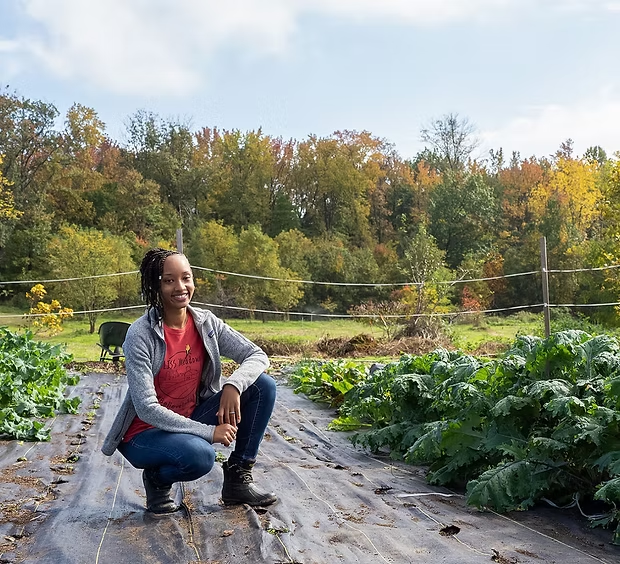
And yet, across city lots and rural fields, passionate young people persist. Even as challenges mount, individuals driven by a belief in the stewardship of Earth and care for their beloved communities seek out available land and dedicate themselves to it. They persist through the many relentless hurdles, their labor and love undeterred, even when the numbers fail to add up in the end.
They are teachers, artists, nurses, professionals, community organizers, and dreamers who see the return to the land as a solution to our increasingly destabilized world.
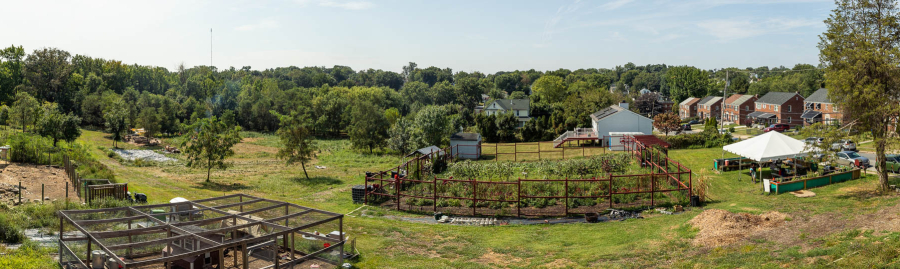
Atiya Wells and Jordan Bethea of Backyard Basecamp are among these land-called visionaries. At BLISS Meadows in the city of Baltimore, they have acquired and reclaimed an abandoned 10-acre parcel of urban land and transformed it into an oasis of nourishment, education, and belonging. Their story of imagination and collective care reflects their commitment to the work of rebuilding our shared relationship to food and land. They remind us that to be called to the land is not simply to grow crops and raise livestock; it is to heal the broken links between people, place, and our own threatened human potential.
Building Legacy at BLISS Meadows
Atiya was working as a pediatric nurse in a hospital when her boyfriend took her on a fateful hike that would change her life’s path forever. At first, the invitation felt like the unsettling start to a classic horror movie, but as they meandered into the woods with ease, she found herself in awe of the beauty that enveloped her and the sense of belonging the natural world freely offered. She went home deeply stirred by the experience with a sense that something important was being called forth from within. She felt compelled to share this connection with her community. Atiya explains, “I wanted to help my community get a deeper understanding of the world that exists with us, to learn that we are a part of nature and we are not separate from it. I also wanted to help people learn how to steward it.”

Atiya set to work and established a program for preschool-aged children and their parents. Every week, she would facilitate the connection between the participants and the natural world. It didn’t take long for Atiya to realize that if she was going to truly foster these budding relationships, she needed to learn more about the natural world herself. She enrolled in a self-paced naturalist course to learn more about the ecological communities around her. In the course, students were encouraged to find a “sit spot,” a quiet place in nature to sit and observe. She thought that this would be a difficult feat in her urban Baltimore environment, but after a quick Google Maps search, she found a small park around the corner from her home. At the park, she found a forest, and after a short trek on a game trail, she came out to an open field and a pond.
Not knowing who the owners of this abandoned parcel were or what the process was to investigate such things, she contacted a local land trust. There, Atiya was guided on how to look up the real estate and tax assessment for the property and eventually found the owners of the land. After connections were made and visions were shared, the property owner donated the land to Atiya’s cause, and the associated farmhouse was purchased to secure the headquarters of what would later become Backyard Basecamp.
Simultaneous to Atiya’s journey into the benefits of deepening the connection between nature and people, she was also learning about the land’s essential role in nourishing us. Atiya recounts, “Around the time that I found the parcel of land, the book Farming While Black by Leah Penniman came out, and through that I learned a lot about food apartheid. I read the pages and thought to myself, ‘this is my community that she’s talking about,’ and I wanted to create a space where we could grow healthy food and educate people about the importance of healthy environments.”
“I wanted to help my community get a deeper understanding of the world that exists with us, to learn that we are a part of nature and we are not separate from it.”
As Atiya’s dreams materialized, she began formulating a team that would transform the abandoned parcel into BLISS Meadows, a community gathering place and hub that would merge natural and cultivated space, and become a beacon of hope for those in their neighborhood and beyond. It was at this time that farmer Jordan Bethea was drawn in. Jordan explains, “When I started, I didn’t have any experience in agriculture; I just had ideals about it. I was struck by what Atiya and the whole Backyard Basecamp team were creating just from their imagination and some stick-to-it-iveness. It started with vegetables and has now cascaded into so much more.”
Tearing Down Old Fences
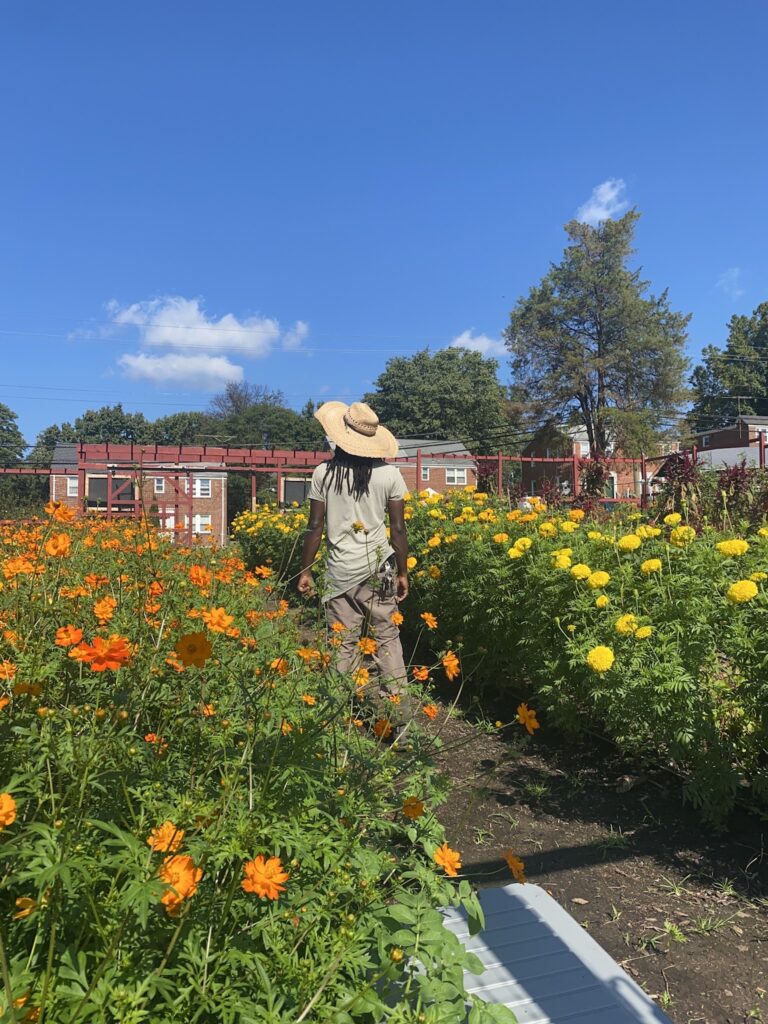
BLISS Meadows has evolved and now boasts vegetable, flower, and herb gardens, a thriving apiary, an orchard, mushroom logs, educational programming, an event space, a seed hub, and more. The entire Backyard Basecamp team has achieved so much in just six years, but it hasn’t always been easy. Atiya notes, “One of our major challenges has been working with the city and within the city as an urban agricultural project. There hasn’t been an impetus for success for this sort of project, so there has been a lot of contention with the different city agencies when it comes to land access, water access, and any active agricultural practices.”
Without the support of the legislature in the city of Baltimore, it is difficult for agricultural endeavors to thrive. In addition to barriers created and enforced by lawmakers, the average person in Baltimore isn’t necessarily aware of the benefits of locally sourced food. Jordan continues, “The farm infrastructure in the Baltimore City area is limited. There are people in the government who don’t want it, and the populace isn’t supporting it. While there is likely a lot of interest in the youth to pursue farming here, there’s not a lot of actual structure for them to learn how to farm or to make a living doing it in the city.”
Due to these challenges, the team at Backyard Basecamp has had to reach out to agencies outside of the city to answer questions and access resources. They’ve needed to dedicate time to teaching their local community about the importance of healthy lands and healthy foods. They’ve been forced to educate the legislature about how imperative access to these fundamental resources is for urban communities, even when the communities may not advocate for this access themselves.
“I wanted to create a space where we could grow healthy food and educate people about the importance of healthy environments.”
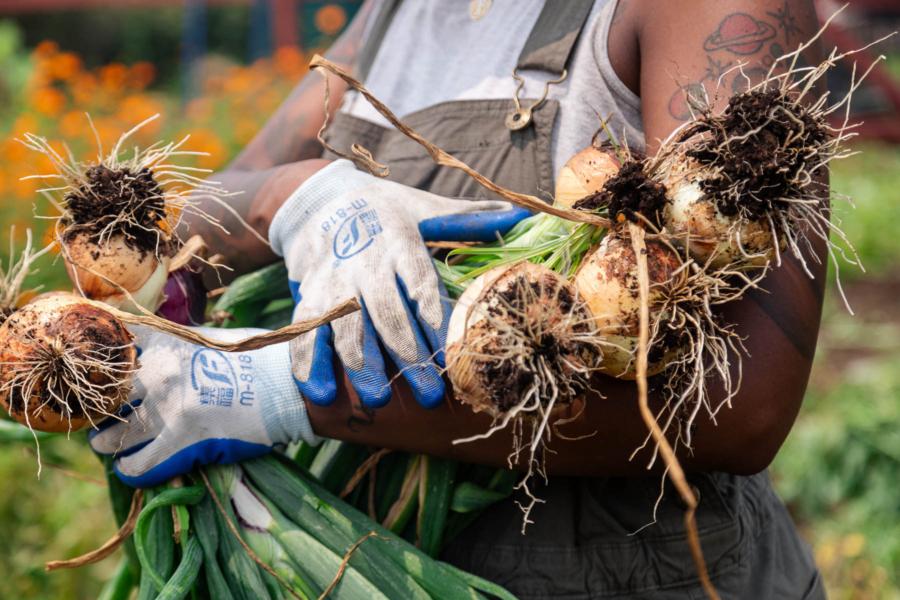
All of this tedious but necessary outreach has sprouted a commitment to total transparency and an open-door policy to anyone interested in what they’re creating at BLISS Meadows. Jordan explains, “When we first started growing on this property, we tore down a long fence along Plainfield Avenue so that it felt much more inviting to the community. We want people to see the food that they are going to purchase growing. There’s no funny business here. Someone asked me once if we sprayed chemicals, and I told them we did not, and they could look in our shed because everything we use is visible.”
Culture Is Cultivated
The disconnect between people and land has been growing for decades and continues today. It is the goal of Backyard Basecamp to not only reconnect those who seek them out for guidance but also to educate people in the community who do not. Jordan elaborates, “The people that we want to serve the most aren’t just people who are bought into the importance of local agriculture, that know and love the freshness of foods that are coming from just a couple of miles away from their home. We’re also trying to access people who are not interested.”
It’s no secret that terms like “organic,” “sustainable,” “all natural,” and “chemical-free” have been co-opted by marketing firms to use as a means to increase the profit margins of their offerings. Often, these terms, even the government-regulated labels, are slapped on heavily processed products that no longer resemble their natural origins, and they are primarily marketed to those with the most means. This “greenwashing” results in a grocery store experience that is gentrified, confusing, and packed with multitudes of conflicting imagery and information. Atiya elaborates, “Farms, farming, and farm labor have all become this nebulous idea in our modern world. When you go to the grocery store, you know that someone probably grew or raised the food you are purchasing, but the details of that aren’t clear to you or spelled out for you. It’s made it so that most people spend their entire lives not really having a clear understanding of where food comes from.”
Atiya and Jordan see the lack of clarity in our food labeling and our lack of engagement with the food system as a huge barrier to our collective well-being. Without a clear understanding of where food comes from, how it is raised and grown, and the journey it has made to reach our plates, we can’t expect to make informed choices. Jordan sees individuals jumping on trends and proselytizing about the latest superfood trends, but he sees a dialing back of cultural practices centered around food traditions. Jordan asserts, “Do you talk to your neighbors about what they’re eating? Do you share recipes with your people? Do you share meals? The traditions of the world center community around shared meals. In the U.S., this only happens for a holiday. We don’t get meaningful conversations around food in our communities because people aren’t having meals with people in their communities in meaningful ways.”
The traditions of the world center community around shared meals. In the U.S., this only happens for a holiday.
Atiya continues, “We offer programs and events that invite people into our spaces and allow them to see what’s happening. We encourage people to really get to know us. We try to offer educational programs to help inform consumers about farming, to help them understand better about how it works, seasonality, and more. There’s a level of food literacy that needs to be remembered and talked about.”
Jordan and Atiya are dedicated to creating opportunities to reignite the community’s passion for cooking, gathering, and coming together in the garden and in the kitchen. When people ask them how they can best learn more about local food, they implore them to get involved. Jordan affirms, “Participation is the first step in helping your local food system. It’s like the very act of being adjacent to this thing gives you important information by osmosis. If you hang out by the library long enough, you’re going to start figuring some things out. By this same virtue, if you are near the people who are growing food, you are going to start getting a better understanding of what is happening.”
Life Without a Living Wage
In addition to the difficulties young farmers face in garnering support from their local legislature and the continual need to educate their potential supporters, next-generation farmers cannot afford to buy farmland and often can’t even make a living from farming as inflation continues its endless and unsustainable climb. As Atiya and Jordan describe, enthusiasm meets a hard economic wall: wages are too low to live on, there are no benefits to sustain a growing family, and land prices continue to spiral beyond reach. Atiya explains, “Challenges that face young farmers include land security, land tenure, and pay. The pay for farmers and farmhands in this area is low, and there’s no opportunity for a livable wage. Even though there are people around who do care where their food comes from and do support their local food system, the farmers cannot sustain themselves by doing this work.”
Jordan confirms and elaborates, “Once every two or three weeks, I’ll just check the local farm bulletin boards for job opportunities. These are generally one of two things: one to be the director or the farm manager at a particular entity, or it’s a farmhand position. There are no specialized positions in between those two roles. For the farmhands, those who will be carrying out the labor, I’ll see $12 to $13 per hour plus all the free spinach you can eat. It blows me away. We say internally that we want to respect the food, but we do nothing to respect the laborers.”
This increasing reality is preventing young people from entering agriculture and from seeing it as a viable option for their future. It is causing people like Atiya and Jordan to question whether encouraging youth to get involved in their local agricultural scene is even an ethical suggestion to make. Jordan poses, “You must ask yourself if it is fair for me to invite young people into this industry where there may not be a great future for them? At the end of the day, the practical things like, ‘How will I pay my bills?’ ‘How will I take care of my body?’ ‘How will I handle the responsibilities of my personal life on the wages of a farm laborer?’ What are we really offering youth in the agriculture space besides sometimes being exploited and even abused?”
“We say internally that we want to respect the food, but we do nothing to respect the laborers.”
If we want regeneration of our land and society, we can’t keep ignoring the gathering red flags and patching an extractive model with grants and goodwill. A truly regenerative food system would value the hands that plant and harvest our essential food sources as much as the soil itself. Without this reckoning, we risk losing an entire generation of land stewards before they’ve even begun. Jordan notes, “Starting people at $12 per hour is not equitable. It’s not reasonable. We must find ways to compensate people, and until we do that, people aren’t going to want to be in the industry. One of my favorite quotes is, ‘If it can be destroyed by the truth, it deserves to be destroyed by the truth.’ In a lot of ways, the farming industry is not doing right by the people that are making a way for every American to eat.”
The Chesapeake Farmland Commons
Yet where the system falls short, communities like Backyard Basecamp are stepping up to build something better; a living example of how equity, ecology, and ownership can coexist. To create and sustain an environment that is healthy for people and their ecological partners; supports the well-being of the local community; and provides safe, long-term, equitable tenure for present and future farmers, Backyard Basecamp has partnered with The Farmers Land Trust to establish the Chesapeake Farmland Commons. This multi-partner, community-centered initiative is designed to secure and steward farmland for regenerative food production in Northeast Baltimore. Together, we are working to transfer farmland into community ownership through a 501(c)(25) structure that ensures land remains in active use for agriculture, education, and community empowerment. With the help of GIS mapping, legal support, and strategic outreach, our collaboration is actively identifying land to expand the acreage and reach of Backyard Basecamp beyond the original BLISS Meadows property, creating a vibrant commons that serves as a living model for equitable land access and collective stewardship.
When many hands share the weight, the burden becomes light.
Rooted in the enduring spirit of BLISS Meadows, the Chesapeake Farmland Commons seeks to cultivate a legacy of land justice, reconnecting Black and Brown communities to the land, food, and ecological wisdom that sustains them. To advance this effort and uplift the vital work being done by Atiya, Jordan, and the entire Backyard Basecamp team, we invite supporters to help seed a future of lasting community resilience and regenerative abundance through donations of any size. As Atiya explains, “As a nonprofit entity that runs a farm, there’s always the question about where our funding will come from. This is especially true with a lot of the federal dollars. A lot of farmers that we know rely heavily on those federal grants. For those to disappear, or for them to suddenly come into question and be uncertain, has the future feeling a little bit bleak.”
When many hands share the weight, the burden becomes light. The vision of the Chesapeake Farmland Commons depends on a collective act of care: neighbors, allies, and community members coming together to invest in the future they want to see. Shared financial support ensures that the responsibility of protecting and nurturing this land does not fall on a few shoulders alone or on the backs of the farmers but is carried by a broad and resilient network of people who believe in food sovereignty, ecological healing, and racial equity. Each contribution, no matter the size, strengthens the foundation of this commons and brings us closer to a self-sustaining model of community ownership, one where the land’s abundance belongs to everyone it nourishes.
Regeneration Is a Collective Inheritance
The Backyard Basecamp team is safeguarding and sharing ancestral wisdom, protecting the natural world, and offering hope to a society that has seemingly lost its way. In a time when land, labor, and legacy are all under strain, their work reminds us that regeneration is something we inherit together and must steward for the future. It’s kept alive through the rhythm of hands in soil, the footsteps of children down the garden beds, and the healing shared by neighbors who come together to lay bare the human experience around the dinner table. True healing is what grows when cities make room for roots and communities support those who are willing to lead the way.
The next generation of farmers is already here. What they need now is for the rest of us to help create the conditions that allow them to flourish. Atiya, ever the visionary, imagines what happens when this kind of support is allowed to bloom: “I’ve always envisioned Backyard Basecamp to be this shining beacon of inspiration and hope in our area, showing people what’s possible when you have a dream and you work to make that thing happen. Similarly, in the food space, I envision us expanding to another site to focus on production. Right now, our site is more like a community gathering space. We farm, grow things, and sell things, but our scale is smaller than we want it to be. If we’re able to expand and grow, we can have more to offer our community, while continuing to provide those educational aspects along the way.”
The Chesapeake Farmland Commons is that next chapter of connection, a living testament to what can grow when a community dares to imagine itself as both steward and beneficiary of the land. Its harvest will not be measured only in crops, but in the collective resilience of people who chose to invest in each other, in equity, and in the long, patient work of reconnecting to the ways of living that are guided by a reverence and support for all life on our shared world.
