

The Story of the Carya Farmland Commons
Narrated by Aleeyah Frye
Founding Farm Location: The founding farm of the Carya Farmland Commons is located in Blue Mounds, Wisconsin
Founding Farm Size: 43 acres
Current Land Use: Perennial tree crop breeding and production, and managed prairie land
Current Land Stewards Involved: Alex Tanke and Emma Kloes
Community Partners: TBD
Date of Incorporation: 2027 (anticipated)
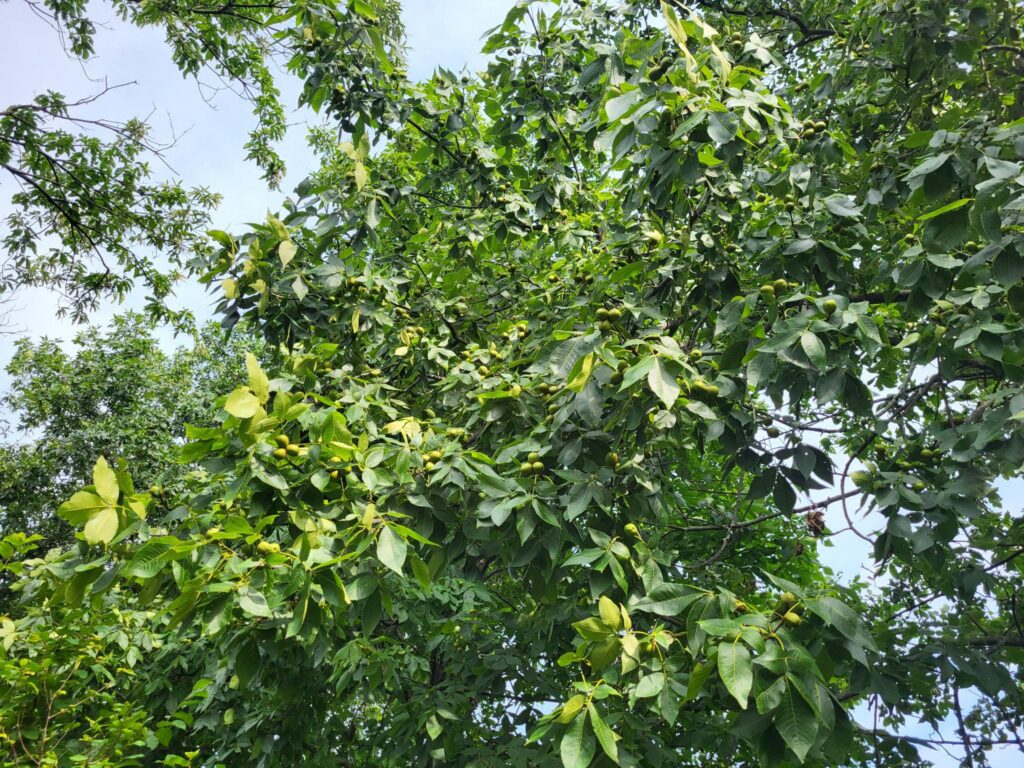
Special Features: 20 acres of managed prairie land and 20 acres of perennial tree crop production. Hybrid hickory production and breeding work is the current focus of the project, with additional plantings and selections of adapted American persimmons and honey locusts. The land also includes a drilled well and farm infrastructure. At Alex’s home on a different property, he maintains a nursery currently stocked with thousands of saplings, a subsistence vegetable garden, and a fruit orchard.

A Visionary Tree Breeder
Alex Tanke is a young tree-crop breeder working at a scale and intensity rarely seen in his region. Alex is building a working repository of hybrid hickories, American persimmons, and honey locusts on 20 acres of the land. This land is a combination of agricultural land and beneficial habitat, featuring thin-soiled ridges and deeper-soiled hollows. Half is managed as prairie, and the other half is maintained for production, with the terrain dictating what parts can be used for what purpose. When he first started working with trees, there were very few reliable hickory, persimmon, or honey locust varieties that were adapted for Wisconsin, and he wanted to change that.
Over the past four years, he has assembled and expanded a germplasm collection tracing back to some of the most important nut-tree projects in the Upper Midwest and Northeast, including the remnants of Carl Weschcke’s clonal hickory nurseries, selections from John Hershey’s historic groves, and genetics from Badgersett Research Farm, and many others; work rooted in a parcel of land that was vulnerable amid an uncertain transition.
Alex Tanke is a young tree-crop breeder working at a scale and intensity rarely seen in his region.
Alex knows the lineage of nearly every tree he plants. He feels a sense of urgency about his work, mostly caused by the patterns of losses that haunt the field of tree breeding. Beloved research groves have been clear-cut, breeding collections bulldozed, and whole lifetimes of work have been lost to foreclosure, development, or even well-intended ecological conservation efforts.
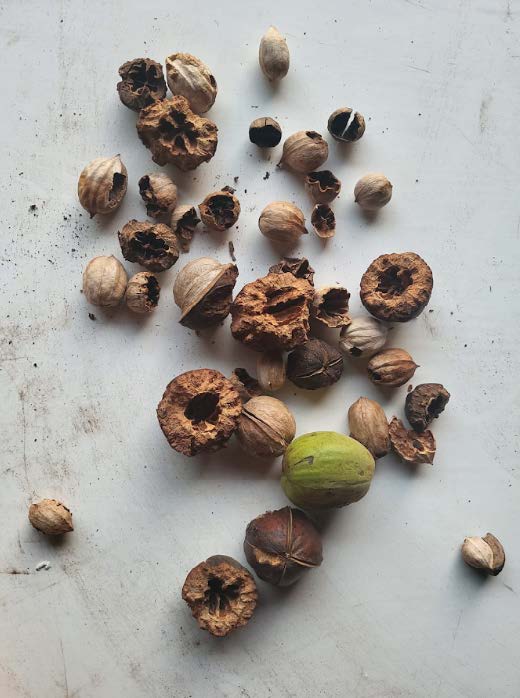
His first memories of hickories are of picking up hickory nuts with his father at a local county park. Alex grew up gardening with his father, a lifelong gardener, and was introduced to perennial crops during college by a farmer from Vitruvian Farms who was giving a talk at horticulture club. Raspberries, apples, and pears were some of the gateways into perennial crops but after years of broader exploration, the focus was gradually directed more and more towards hickories.
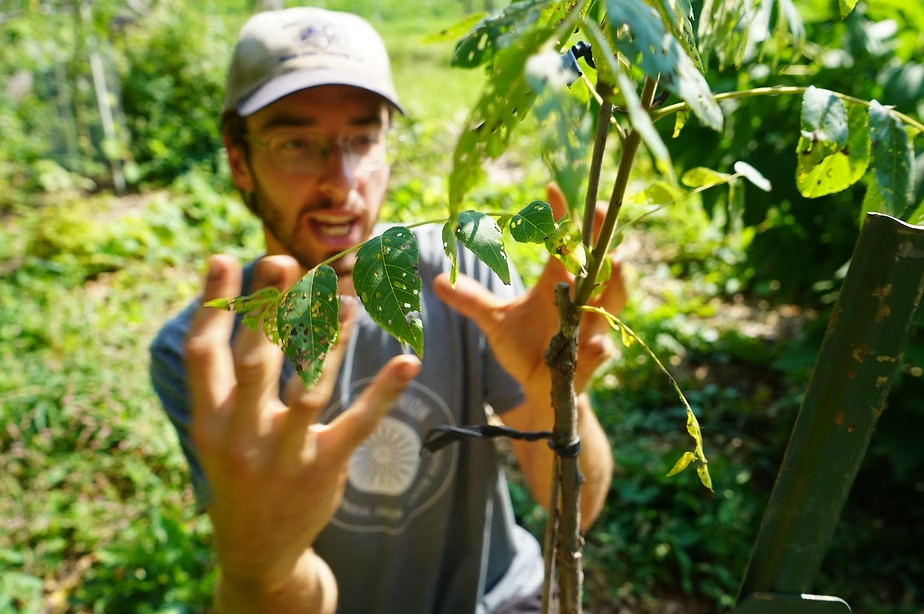
Unlike annuals that require soil disturbance and intensive tending, Alex saw that food-bearing trees and shrubs are planted once and then cared for through low intensity yearly rhythms of pruning, mulching, and fertilizing. After a few early years of tending, they need little weeding, no tillage, and far fewer fossil fuel inputs, while yielding more abundantly each season. This approach to food production has the potential to be multigenerational, coming into production within years and feeding people for decades if not centuries.
Following this lead, Alex began learning breeding techniques from people who worked within and outside academic conventions. This included breeder Philip Rutter of Badgersett Research Farm’s unorthodox hybrid-swarm approach, which encourages crossing plants with unusual traits on the chance they’ll unlock unexpected breakthroughs. Today, Alex combines the best of what he’s learned from others, planting thousands of seedlings only inches apart, culling fast and often, preserving a mix of the most promising traits as well as many of the unusual.
Alex tends clonal hickory orchards and keeps tens of thousands of young trees in motion. He has spent countless hours running experiments in his basement to solve hickory’s most challenging bottlenecks, including viable clonal propagation methods and efficient nut processing for kernel. From this effort, Alex has successfully built a nutcracker that processes one nut every few seconds, and he believes that in the next few years he will push the process even faster, allowing hickories to compete with the pecan industry. To him, breeding and production are inseparable, and a breeder who doesn’t understand production can’t serve the fitting genetics to the growers.
This approach to food production has the potential to be multigenerational, coming into production within years and feeding people for decades if not centuries.
Alex found his way to land ownership after the unfortunate passing of his father. Years before, he was landless, having just left his job as an engineer, he began giving away plants through an organization he created called The Neighborhood Planting Project. During his early explorations of tree breeding, a family friend gave him access to a degraded 10-acre horse pasture. He took it on as a lease, began planting and stewarding the land, and within a few years, he found himself as the caretaker of 43 acres of land. The land was a part of a 250-acre parcel destined to be donated to a prairie conservation organization that wanted to preserve the land for a grassland bird habitat. The University of Wisconsin has designated this particular area as an essential habitat for the birds, as these ecotypes have mostly been lost in the state.
Due to his relationship with the landowner and history tending the land, he was offered to purchase the 43 acres at a deep discount. At the time, Alex had already invested years of labor, adding value to the land without any guarantee he would be able to keep it. The inheritance he received after his father’s passing allowed him to buy the land outright, and his efforts on the property were protected.
Today’s farms and perennial nurseries need protection from chemical drift, cross-contamination, and unwanted pollination associated with industry, industrial agriculture, and residentially managed landscapes. Fortunately for Alex and all future stewards of the property, this 43-acre site benefits from a natural buffer provided by the 1,000 or so acres of conserved prairie land to the west and North of the land. This buffer creates a healthy, native ecosystem beyond the farm’s boundaries and serves as an important oasis for native biodiversity. As Alex’s groves mature, the ecological contribution of his work will weave seamlessly into this dynamic landscape and provide even more benefits to the greater bioregion.

What Alex wants now is permanence beyond his lifetime. Hickories can take 15 years to bear and half a century to peak. Tomorrow is never guaranteed for any of us and a sudden car accident could erase his entire arc of intention. Alex has seen too many groves vanish when ownership passes to disinterested heirs or gets sold on the commercial real estate market. Leasing land doesn’t offer enough protection for long-term tree crops, and conventional conservation easements don’t offer specific protections for the preservation of trees on the landscape.
As soon as Alex became the legal owner of the land, he began pursuing protection through a land trust. Years before on a visit to Downingtown, Pennsylvania, with tree breeder and mentor Buzz Fervor to collect propagation material from the remnants of John Hershey’s historic groves, Alex was distressed by the horrible condition of the grove. The majority of the Hershey grove had been developed into condominiums, and years of research, genetics, and growth vanished. Alex knew that he needed to do something to prevent future tree breeding work from being lost to the senseless commodification of land and natural resources.
…the ecological contribution of his work will weave seamlessly into this dynamic landscape and provide even more benefits to the greater bioregion.
It was these concerns that led Alex to transfer ownership through the donation of the land into The Farmers Land Trust, to seed the creation of the Carya Farmland Commons. Within the Farmland Commons Model, he can write the preservation of his germplasm directly into the management plan, set long-term agreements for how trees are protected or removed, and ensure that future stewards are chosen for their skill and interest in tree crop breeding and/or production. His own children will have an ability to manage the land if they are the best fits as stewards, but no one will be bound by familial pressure or burdened by asset value.
Sometimes the lessons learned from hardships are foundational experiences that build who we are meant to become. The passing of Alex’s father was a difficult loss but even his unexpected passing was a lesson that even life is not something to be taken for granted. His father gave him the gift of awe for plants and trees and at the time of his passing, he also gave him the means to protect them. Alex speaks often about the wisdom of different life stages, and the way both the living and the dead shaping the world. He sees land trusts as part of that continuum, a structure that steadies the hands of those living now and protects the work of those before us for generations to come.
The Carya Farmland Commons as a Vessel
The Farmland Commons Model is a structure capable of holding what private ownership cannot. With this model, intention can span across lifetimes, stability can be assured for long-horizon crops, and a shared ethic can be passed down that outlives individual stewards. Tree crops like hybrid hickories, American persimmons, and honey locust don’t abide by human timelines. The trees mature on the scale of years and peak on the scale of decades, which means the work of breeding and selecting them demands a form of tenure that must be immune to the usual churn of land markets, inheritances, divorces, debt, speculative pressures, and the abrupt preferences of new owners. The Farmland Commons Model turns that vulnerability inside out. It separates stewardship and use from ownership, so the land itself becomes the constant, and the people tending it can change without losing the carefully designed systems, infrastructure, and genetic legacy embedded safely in the soil.
In Alex’s case, the Commons becomes the safeguard for irreplaceable germplasm gathered from sites already threatened. Conventional tools like conservation easements aren’t enough for this kind of long-arc breeding work because they can only limit development without guaranteeing continuity of land use. While conservation easements speak to stewardship as an ideal, they are limited to only very general monitoring and enforcement and are not actually engaged in active use or stewardship. The Farmland Commons structure creates a living agreement in which the original steward sets the intentions for the land as a part of the farm management plan, and the community involved in creating and sustaining the Commons carries those intentions forward as part of the Common’s bylaws.
For tree crops with 12- to 15-year juvenile phases, the Farmland Commons solves the problem of time. A single accident or early death no longer threatens the work. A short-term lease can’t interrupt the grove’s maturation, and family dynamics can’t derail the continuity of care. Instead, the land enters a shared framework where each new steward takes up the work in alignment with what came before. The model also expands access. Those who can’t afford land have the option to step into stewardship roles without having to buy property outright. The commons model also offers a bargaining chip for reduced land costs for farmers negotiating land costs into affordable ranges. It honors a truth that Alex knows all too well, that land is not a commodity to be acquired, but instead is a living community to which the steward is a part.
The Farmland Commons Model reshapes intergenerational dynamics with a gentler hand. Instead of relying on inheritance or sale to transition land, it invites all who love the land to have the option to contribute their life’s work to a structure that will support future stewards and preserve their legacy long after they are gone. The land remains as a teacher instead of as an asset, and the elder’s role extends into the future through the agreements they help craft. For someone working with slow crops, vulnerable genetics, and precarious land histories, the Farmland Commons can be used as a vessel built to hold century’s worth of intention.
It honors a truth that Alex knows all too well, that land is not a commodity to be acquired, but instead is a living community to which the steward is a part.
Creating the Commons
We invite individuals to sign up for the Carya Farmland Commons newsletter and stay connected to this evolving vision. We warmly encourage nonprofit organizations rooted in the Driftless Region of Wisconsin, as well as those across the country who share aligned values, to reach out and explore opportunities to engage. This is more than a call for participation; it is a unique invitation for aligned nonprofits to actively co-create the Farmland Commons alongside us, shaping a collaborative model of land stewardship grounded in shared purpose and collective care.
If you are a member of a nonprofit that shares a similar mission or know of one that would be interested in collaborating, we’d love to hear from you today.
A Call to Action
If you feel called to support this work, consider hosting a small fundraiser to benefit the Carya Farmland Commons Project. A simple gathering, dinner, house concert, or community event can help seed the resources needed to grow this shared vision. Collective stewardship begins with collective action, and even modest contributions can help bring the Carya Farmland Commons to life.
Get Involved
Community support is a fundamental part of the creation of a successful Farmland Commons. If you’d like to get involved with the Carya Farmland Commons project, there are a few ways you could really help the project thrive.
Ways to Support:
o Make a one-time or monthly tax-deductible donation today!
o Join the Commons project as a collaborative nonprofit partner.
o Reach out to us today to learn more about the multiple opportunities to engage with the Carya Farmland Commons.
